所以到底什么是写作质量? 其实就是研究如何以字面完整呈现。 即使写作质量并不完全显现研究的严谨与意义,但却会影响其他研究员和期刊编辑阅读。身为一个杰出的研究员和教授Dr. Paul T. Wong 在他的“7 Common Reasons Why Manuscripts Are Rejected,”中表明,只要看一眼论文就可以知道写作质量是否达到发表水平, 这也是为什么写论文草稿时就应该要注意写作质量的原因。
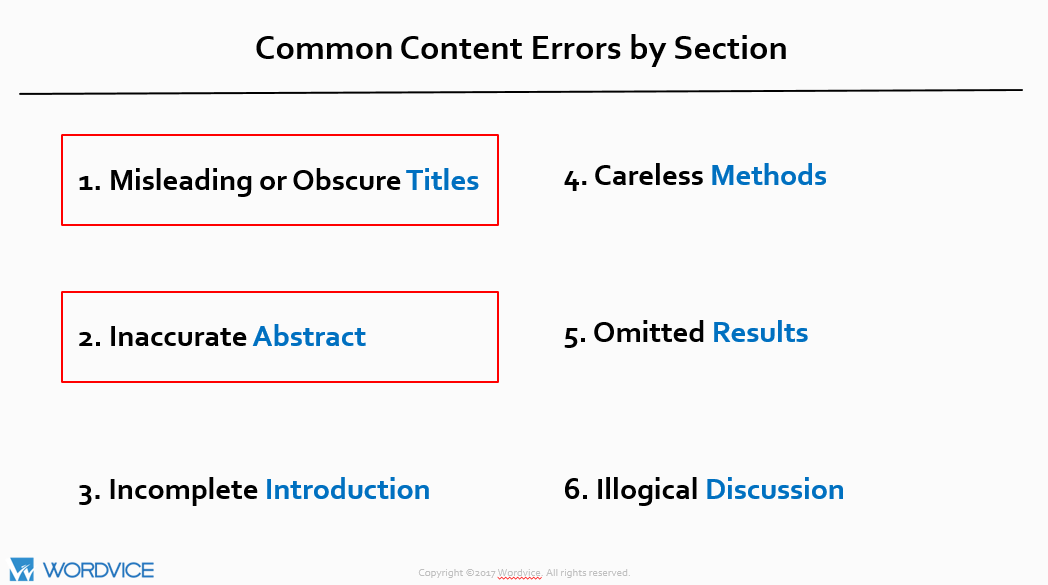
Consistency of material: Is the material consistent and logical in its exposition? Does the title match the actual topic? Is the abstract up to date with all of the findings in the paper?
Inclusion of appropriate content: Is everything included that needs to be? Do the introductions, methods, results, and discussions sections include all of the necessary information?
Keep it short—one recent study showed that articles with shorter titles are viewed and cited more frequently.
Don’t write in complete sentences when a phrase will work even better.
Never use abbreviations just to save space—it looks highly unprofessional and also won’t get as many keyword hits in a search.
Narrow the scope of your title—If your paper is a cross-sectional study of a gastrointestinal diseases in 70-80 year-olds in Seville, Spain, writing a title that reads “Disorders of the Stomach in Elderly Spanish People” is not going to give readers a good idea of what your paper really covers.
Strike a balance for the keywords–not too general, not too specific.
Narrow the scope of your title—If your paper is a cross-sectional study of a gastrointestinal diseases in 70-80 year-olds in Seville, Spain, writing a title that reads “Disorders of the Stomach in Elderly Spanish People” is not going to give readers a good idea of what your paper really covers.
How do you know when you’ve written enough information in the abstract? A simple rule-of-thumb is to imagine that you are another researcher doing a similar study. Then ask yourself: if your abstract was the only part of the paper you could access, would you be happy with the amount of information presented there? Does it tell the whole story about your study? If the answer is “no” then the abstract likely needs to be revised. Even better, give your abstract to another reader and ask them if they understand the important aspects of your study.
It is crucial to determine which type of abstract a given journal recommends or accepts. If you write an unstructured abstract when the journal calls for a structured one, or a descriptive type when it should be informative, you are not helping make a good impression on the journal editor.
Every journal has its own guidelines for abstracts. Whether it be formatting (schools of style, word count, heading rules, etc.) or preference for passive voice over active, the form and style of a journal’s manuscripts can be central to its identity and connecting to its readership and are thus strictly adhered to. A golden rule of journal submissions is to check the submissions guidelines of every journal you submit to.
The abstract should remain clear and free of any unnecessary or extraneous details. This includes…